
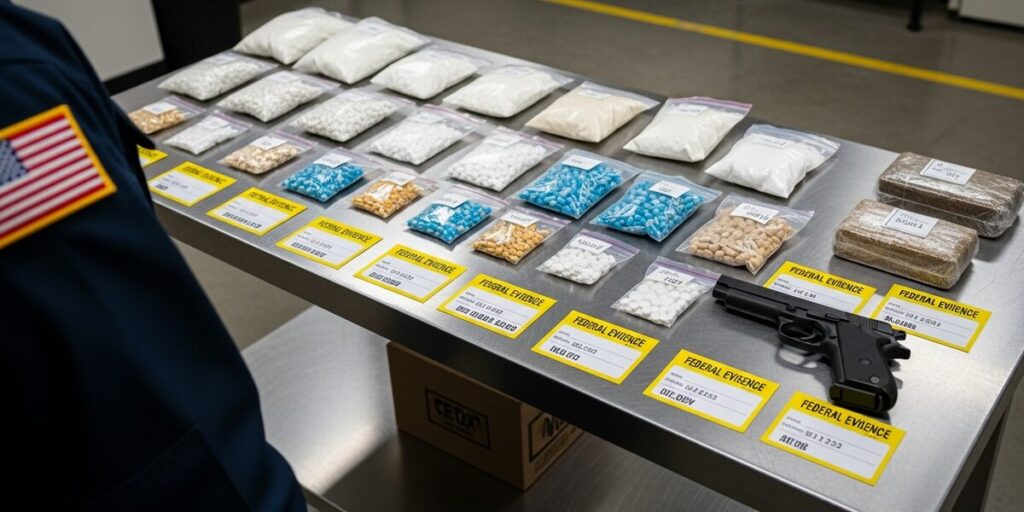
Fifty-five arrests. One morning. One operation.
The FBI rolled up an entire drug trafficking organization based in Georgia that was pumping fentanyl into American communities — supplied by a source in China.
They called it Operation Powder Island.
Five FBI field offices — Atlanta, Jacksonville, Charlotte, Dallas, and Buffalo — coordinated simultaneously. Fifty-six federal arrest warrants executed on narcotics and gun charges. Fifty-four suspects taken into custody across multiple jurisdictions. One more surrendering next week. One more upon returning from travel.
SWAT teams from Atlanta and Jacksonville provided tactical support.
This is what federal law enforcement looks like when it’s actually allowed to do its job.
The China Connection
Investigators identified at least one suspect who was communicating directly with an overseas supplier based in China.
This is the pipeline that’s killing Americans.
Chinese chemical manufacturers produce fentanyl precursors. Those precursors are shipped — sometimes through Mexico, sometimes directly — to distribution networks inside the United States. Those networks cut, package, and distribute the product into American communities.
The Georgia ring was one node in that pipeline. One organization among hundreds. One operation in one state connected to a supply chain that stretches across the Pacific.
Every major fentanyl investigation leads back to the same place: China.
Not Mexico. Mexico is the transit point. China is the source. Chinese chemical companies manufacture the precursors that Mexican cartels press into pills that American distributors sell on American streets.
The FBI just proved it again. A Georgia drug ring. A Chinese supplier. American bodies in between.
30% More Narcotics Seized
FBI Director Kash Patel put numbers to the enforcement surge.
“This FBI has initiated an aggressive, nationwide takedown of drug trafficking organizations at levels never seen, taking over 30% more deadly narcotics off the streets in 2025 than the year prior.”
Thirty percent more in one year.
That’s not a marginal improvement. That’s a fundamental shift in enforcement posture.
Under Biden, the FBI was focused on parents at school board meetings, Catholic churchgoers, and social media posts. Drug trafficking organizations operated with relative freedom while the Bureau chased political targets.
Under Trump and Patel, the FBI is doing what it was designed to do: dismantle criminal organizations that kill Americans.
Fifty-five arrests in a single operation. Thirty percent more seizures year over year. And this is just one bust in one state.
“Operation Powder Island”
The name tells you the scope.
This wasn’t a street-level bust. This was an organizational takedown. The target was the network — its leadership, its distribution chains, its supply connections, its funding mechanisms.
Fifty-six federal warrants across multiple jurisdictions means months of investigation. Wiretaps. Surveillance. Controlled purchases. Financial tracking. Cooperating witnesses.
The FBI didn’t stumble onto 55 suspects. They mapped an entire organization, identified every participant, built federal cases against each one, and executed a coordinated takedown designed to collapse the entire network simultaneously.
When you arrest everyone at once, nobody can warn anyone else. Nobody can destroy evidence. Nobody can flee.
The organization woke up Wednesday morning as a functioning drug enterprise. By noon, it was 55 people in federal custody and a network in ruins.
Fentanyl: The Numbers Nobody Can Ignore
Fentanyl is now the leading cause of death for Americans aged 18 to 45. Not car accidents. Not cancer. Not suicide. Fentanyl.
Over 100,000 Americans die of drug overdoses annually. The majority involve synthetic opioids — primarily fentanyl.
A lethal dose of fentanyl is two milligrams. Two milligrams. A few grains of salt worth of powder can kill a grown man.
The drug is pressed into counterfeit pills designed to look like legitimate prescription medications. Users who think they’re taking a Percocet or an Adderall are actually taking fentanyl. One pill can kill.
The Georgia ring was distributing this product throughout the state and beyond. Every day they operated, people died.
Five Field Offices, One Mission
The geographic scope of the operation reveals how drug networks actually function.
Atlanta was the hub. But the network reached into Florida, the Carolinas, Texas, and New York.
That’s why five FBI field offices coordinated. Drug trafficking doesn’t respect state lines. A Georgia-based organization distributes to customers in multiple states, receives supply from international sources, and moves money through financial networks that span the country.
Dismantling that kind of network requires the kind of multi-jurisdictional coordination that federal agencies are uniquely equipped to provide.
Local police can arrest street dealers. Only the FBI can map an entire organization, trace its international supply chain, and execute a synchronized takedown across five states in a single morning.
Violent Crime Arrests Doubled
The fentanyl operation isn’t happening in isolation.
FBI violent crime arrests have doubled in Trump’s first year compared to the Biden era.
Doubled. Not increased. Doubled.
Drug trafficking organizations don’t just sell drugs. They enforce territory through violence. They eliminate competition through murder. They protect their operations through intimidation.
When you dismantle drug networks, violent crime drops. When you arrest traffickers, the murders they commit stop. When you cut supply lines, the turf wars they generate disappear.
The FBI’s dual surge — more drug seizures and more violent crime arrests — reflects a single strategic shift: targeting the organizations that produce both drugs and violence simultaneously.
Chicago Crime Dropped After Federal Operations
DHS reported that Chicago crime dropped sharply after federal operations targeting criminal illegal immigrants.
The same pattern applies to drug enforcement. When federal agencies target the organizations that drive crime — whether immigration-related or narcotics-related — crime falls.
This isn’t complicated. It’s cause and effect. Arrest the people committing crimes, and crime decreases.
The Biden administration’s approach was the opposite: reduce enforcement, reduce arrests, reduce consequences. Crime surged. Overdose deaths hit records. Fentanyl flooded every community in America.
Trump’s approach: maximum enforcement, maximum arrests, maximum consequences. Crime falls. Seizures increase. Organizations collapse.
One approach works. The other one killed over 100,000 Americans per year.
Patel’s FBI Has a Different Mission
Kash Patel’s statement on the operation contained a phrase that would never have appeared under previous leadership.
“Eliminating not just the traffickers themselves but also the funding and supply networks that make the criminal activity possible.”
Not just the dealers. The funding. The supply networks. The infrastructure.
Previous FBI leadership would have celebrated 55 arrests and moved on. Patel is signaling that the arrests are the beginning, not the end. The next phase targets the money and the supply chain — including the Chinese sources feeding precursors into American distribution networks.
That’s the difference between enforcement and eradication. Enforcement catches criminals. Eradication destroys the systems that produce them.
“24/7, Full Throttle”
Patel closed his statement with a promise.
“24/7, full throttle mission to save lives and take these narcotics off the street each and every day.”
Every day. Not when politically convenient. Not when the media is watching. Not when an election approaches. Every day.
Fifty-five arrests on a Wednesday morning in Georgia. Thirty percent more seizures than last year. Violent crime arrests doubled.
Somewhere in China, a chemical manufacturer is reading about Operation Powder Island and calculating whether the American market is still worth the risk.
Somewhere in Georgia, 55 people are sitting in federal custody realizing that the rules have changed.
And somewhere in America, a family that would have lost a son or daughter to a fentanyl pill this week won’t — because the organization that would have sold it no longer exists.
That’s what law enforcement looks like when the people running it actually want to enforce the law.