
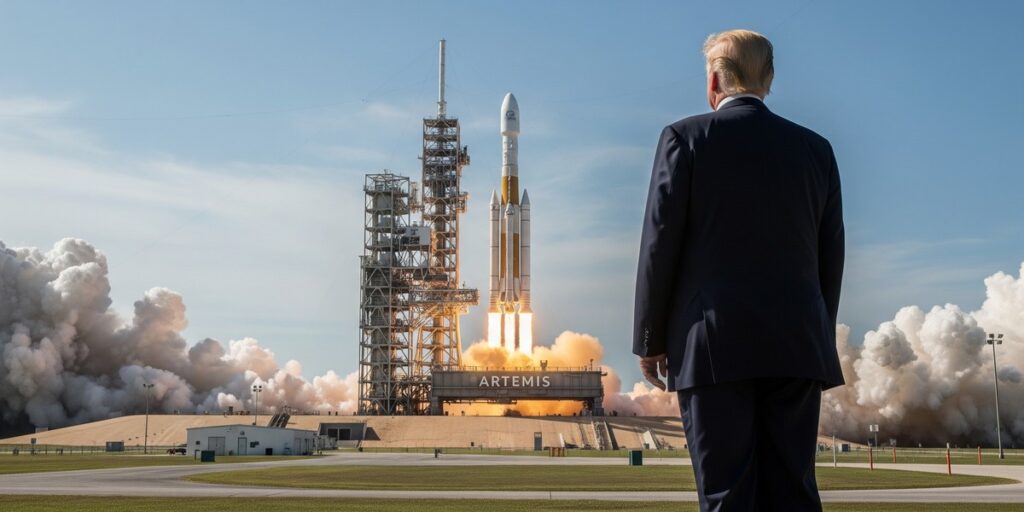
The last time American boots left prints on lunar dust, Richard Nixon was in the White House, gas cost 36 cents a gallon, and the most advanced phone in the country was bolted to a kitchen wall. That was 1972. For over half a century, the greatest spacefaring nation in human history just… stopped going. We built the Space Shuttle, parked it in museums, hitched rides with the Russians, and spent decades letting bureaucrats turn NASA into a jobs program with rocket-shaped paperweights.
Then Donald Trump walked in and said, “We’re going back.”
On Wednesday evening, Artemis II roared off the launchpad and sent four astronauts hurtling beyond low-Earth orbit — farther from this planet than any human being has traveled since the Apollo era. Not a test dummy. Not a satellite. Four living, breathing Americans (and one brave Canadian) strapped to one of the most powerful rockets ever constructed, aimed straight at the moon.
Hours before liftoff, Trump took to Truth Social with the kind of enthusiasm only a man who started this whole program could muster:
“Tonight at 6:24 P.M. EST, for the first time in over 50 YEARS, America is going back to the Moon! Artemis II, among the most powerful rockets ever built, is launching our Brave Astronauts farther into Deep Space than any human has EVER gone.”
All caps? Sure. Warranted? Absolutely.
A Program Born in Trump’s First Term
Here’s the part the media would love you to forget: Trump established the Artemis program back in 2017, during his first term. While the Beltway crowd was busy with impeachment theater and Russia hoaxes, the man was quietly rebuilding America’s space ambitions from scratch. No fanfare. No celebrity galas. Just policy, funding, and a clear directive — get Americans back to the moon, and then aim for Mars.
Of course, nothing involving government rockets goes smoothly. Artemis II was supposed to launch earlier but got delayed by fuel leaks, helium issues, and the kind of technical hiccups that happen when you’re building something genuinely ambitious instead of just PowerPoint slides about diversity initiatives. The Space Launch System needed repairs. They made them. And Wednesday night, the thing flew.
The Crew and the Mission
Astronauts Reid Wiseman, Victor Glover, Christina Koch, and Canadian Space Agency astronaut Jeremy Hansen are now circling the moon — the first crewed mission beyond low-Earth orbit since Apollo 17. They won’t land on the surface this time. That’s coming. Artemis III is scheduled for 2027 to test commercial landers from SpaceX and Blue Origin, and Artemis IV in 2028 will put boots on the lunar ground for the first time in 56 years.
Read that timeline again. Trump didn’t just restart the space program — he built a pipeline. Moon orbit, then lander tests, then touchdown, then Mars. That’s not a campaign slogan. That’s an actual plan with actual rockets and actual humans executing it.
The Bigger Picture
NASA itself has said the Artemis missions are stepping stones toward putting a human on Mars. Their own website spells it out plainly:
“Under Artemis, NASA will send astronauts on increasingly difficult missions to explore more of the Moon for scientific discovery, economic benefits, and to build on our foundation for the first crewed missions to Mars.”
Scientific discovery. Economic benefits. Mars. That’s the kind of sentence that should make every American’s chest puff out a little. While China races to plant its flag on the lunar surface and Europe debates committee formations, the United States just sent humans around the moon with a roadmap that ends on another planet entirely.
And here’s what gets lost in the nightly news cycle — this matters beyond politics. Space exploration is the one arena where American exceptionalism isn’t a talking point, it’s a measurable fact. We went to the moon six times. Nobody else has gone once. Artemis is the program that keeps that legacy alive instead of letting it rot in a Smithsonian exhibit.
Trump didn’t tiptoe around America’s space decline — he grabbed it by the scruff and launched it into orbit. Literally. The man who built the program in his first term just watched it carry astronauts past the moon in his second. Whatever else history says about the 45th and 47th president, it’ll have to include this: he looked up when everyone else was looking down.
Fifty-four years of stalling, and one rocket just ended the drought. Next stop, the surface. After that? The red planet. Buckle up.