
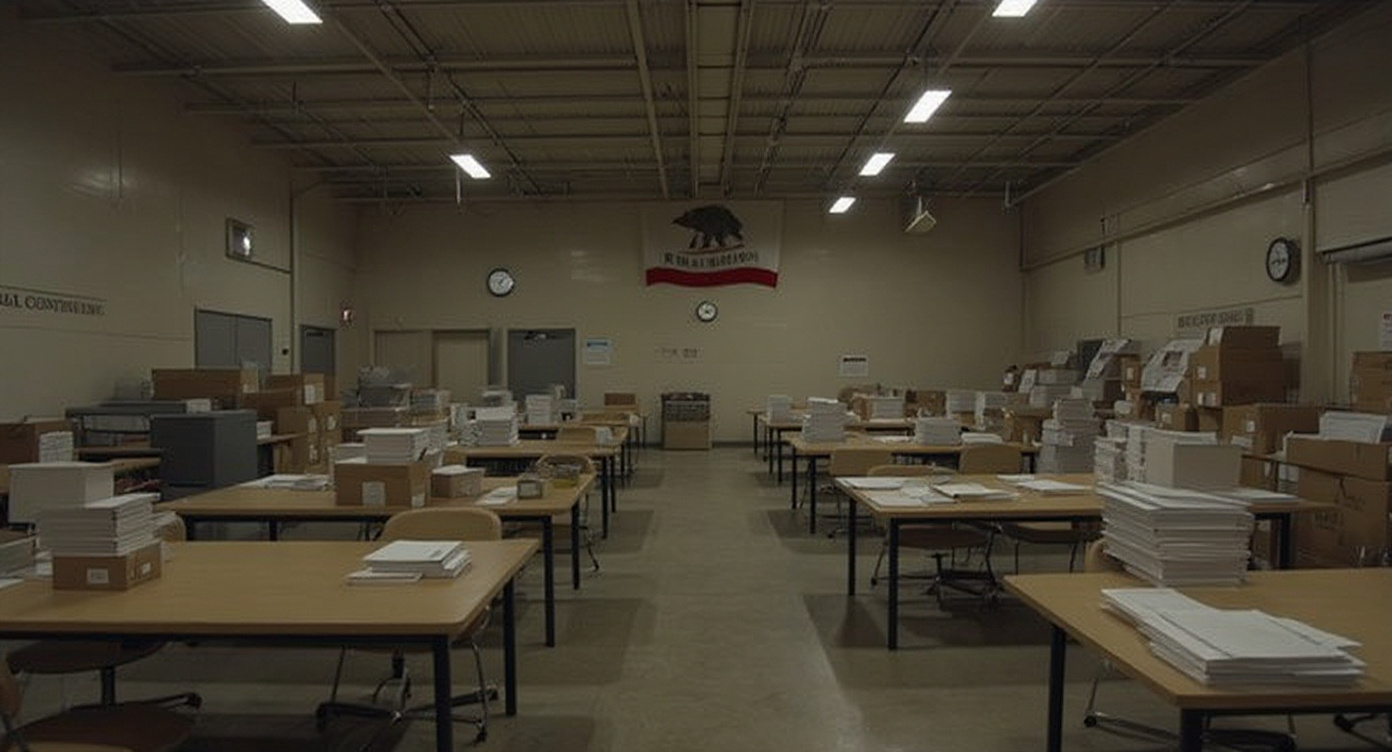
It's June 2026, and the great state of California still hasn't figured out how many people voted on Election Day. As of June 4th — two full days after polls closed — NBC estimated that only 56% of the statewide vote had been counted. That's not a rounding error. That's a state with the GDP of a mid-tier European nation that apparently can't do basic arithmetic on a deadline.
But sure, let's keep lecturing the rest of the country about "democracy."
The most entertaining dumpster fire is the Los Angeles mayoral primary, where incumbent Democrat Karen Bass and Republican challenger Spencer Pratt appeared to be the top two finishers on election night. Third-place leftist Nithya Raman reportedly cried that evening, thinking she'd lost. Fast forward a few days of mysterious mail-in ballot batches "trickling in," and prediction markets now give Raman a 71% chance of advancing past Pratt. Funny how that works.
The previous day's count sat at 57.5% statewide, meaning California managed to process roughly 1.5 percentage points of its own ballots in a 24-hour span. At that rate, we'll have final results sometime around the heat death of the universe. Or at least well after anyone stopped paying attention — which, of course, is the entire point.
This is all by design, folks. California implemented mass mail-in balloting after 2016 election reforms that turned Election Day into Election Quarter. The state permits absurdly long counting timelines, and Governor Gavin Newsom has defended the current system as perfectly fine. Because when you're a Democrat running a one-party state, slow counting isn't a bug — it's a feature.
Even liberal journalist Nate Silver — not exactly a card-carrying member of the MAGA coalition — called the delays "failed state s—." When Nate Silver is roasting your election infrastructure, you know you've achieved something truly special.
The Los Angeles Times, hardly a bastion of conservative thought, has questioned whether the counting speed could improve. That's the Los Angeles Times essentially saying, "Hey, maybe we should try being a functional government?" When your hometown paper is gently suggesting you learn to count faster, the bar is underground.
President Trump, Governor Ron DeSantis, and Senator Mike Lee have all raised concerns that these glacial counting timelines create fertile ground for manipulation. And they're right. You don't need a conspiracy theory when the system itself is built to accept ballots long after anyone can meaningfully observe the process. Transparency requires timeliness. You can't verify what you can't see happening in real time.
Florida — a state with nearly as many voters — counts its ballots on election night. Texas does it. Ohio does it. But California, with all its Silicon Valley genius and tech billionaire tax revenue, needs weeks. We put a man on the moon in 1969 with less computing power than a modern toaster, but Sacramento can't tally paper in 2026.
The Nithya Raman situation is a perfect case study. She lost on election night. Visibly, publicly, tearfully lost. And now, days later, she's the frontrunner — thanks to mail-in ballots that just keep materializing like a magician pulling scarves from a hat. Maybe every single one of those ballots is legitimate. But the system California built makes it impossible to have confidence either way, and that's the real outrage.
As AMAC reported, the slow-roll counting isn't just inconvenient — it's corrosive to public trust. When 44% of your state's votes are still uncounted days after an election, you're not running a democracy. You're running a suggestion box with a very long processing time.
Every other major state in the union manages to deliver results on election night. California's refusal to do the same isn't incompetence — it's a choice. And until voters in the Golden State demand better, they'll keep getting exactly what their one-party government wants them to have: confusion, delay, and results that conveniently shift leftward with every passing day.