
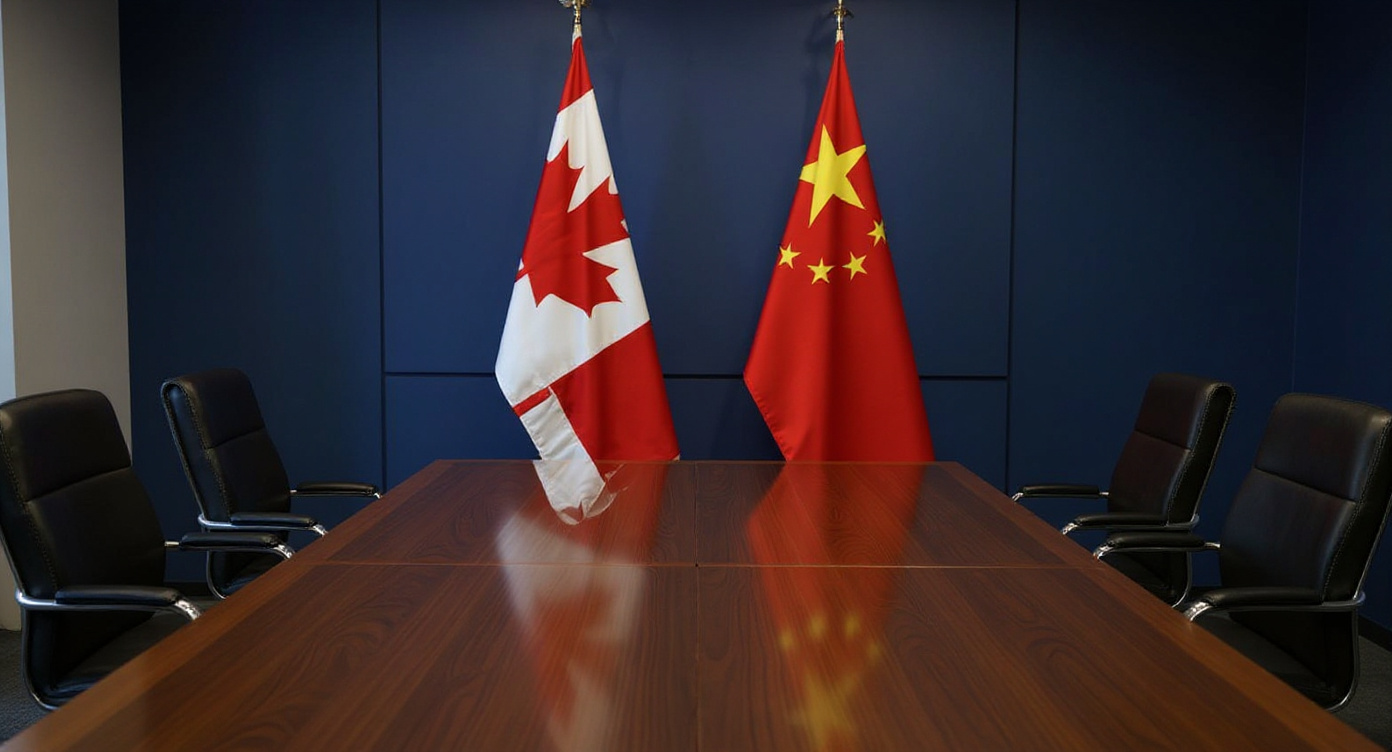
Canada just reopened military-to-military talks with China for the first time in eight years. The last time the two countries held their Defense Coordination Dialogue was April 2018 — back when Justin Trudeau was still pretending to be tough on Beijing and the world hadn't yet watched a Chinese spy balloon drift across North America.
The timing is not subtle.
Canadian Prime Minister Mark Carney's government revived the dormant military channel with Beijing at the exact moment Canada's relationship with the United States is at its most strained in modern memory. Trade tensions over tariffs have escalated. And rather than work through the friction with their actual closest ally — the country that shares their longest border, their largest trade relationship, and their continental defense architecture — Ottawa picked up the phone and called Xi Jinping first.
The South China Morning Post, which reported on the resumed talks, framed it as a pragmatic diplomatic move. That's one way to describe it. Another way is that Canada is conducting a geopolitical spite play — signaling to Washington that if the tariffs don't ease up, they've got other friends to sit with at lunch.
Except these "other friends" happen to be running concentration camps in Xinjiang, threatening Taiwan on a weekly basis, and operating an intelligence network that has thoroughly penetrated Canadian institutions. The fact that Canada froze the Defense Coordination Dialogue in the first place wasn't arbitrary — it was a response to mounting evidence of Chinese interference in Canadian domestic politics, academic espionage, and economic coercion.
Eight years of silence. And the thing that broke it wasn't a change in China's behavior. It was a trade disagreement with the Americans.
Carney, who replaced Trudeau as Liberal Party leader, has tried to position himself as a more serious operator than his predecessor. But reopening a military dialogue with Beijing — not because China earned it, but because Washington annoyed you — is not seriousness. It's leverage theater. And the audience isn't even buying tickets.
China will happily accept every meeting Canada offers. They'll nod through the dialogue, issue a joint statement about "mutual respect" and "rules-based order," and continue doing exactly what they've been doing: expanding military capability in the South China Sea, stealing intellectual property from Western nations, and running influence operations inside Canadian borders. Beijing doesn't need Canada's military cooperation. They need the photo op — a Western democracy voluntarily re-engaging after years of justified distance.
Mark Carney just handed them one, framed and matted, from the Great Hall of the People.
The Canadian argument, presumably, is that maintaining open channels with all major powers is standard diplomacy. Which would be more convincing if the timing weren't so transparently reactive. You don't resume a frozen military relationship with an adversarial power the same week you're publicly feuding with your closest ally and expect anyone to read it as routine.
Canada's trade relationship with China is a fraction of its trade with the United States. Its security architecture is built entirely around American partnership — NORAD, Five Eyes, NATO's North American pillar. The economic and military math doesn't support pivoting toward Beijing. The only math that does is political: Carney needs a pressure card to play against Washington, and this is the one he picked.
The problem with bluffing is that sometimes the other side calls it. And sometimes the country you're bluffing with takes the gesture seriously and starts expecting more.