
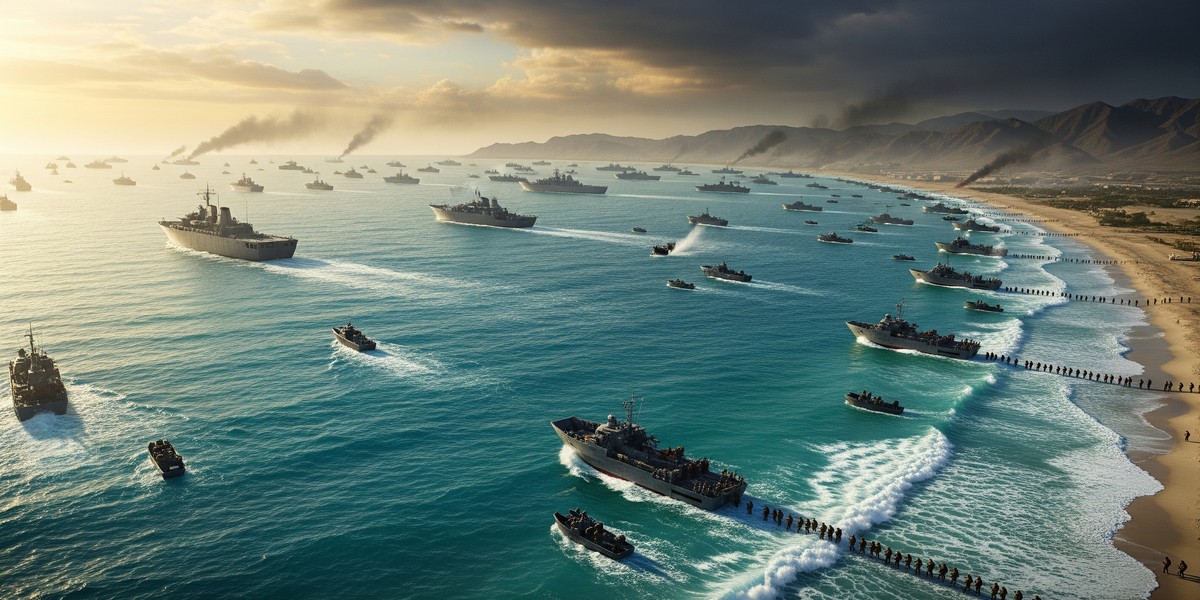
The last time any military wiped out an entire navy in a matter of weeks, the world was fighting fascism and sailors were writing letters home by candlelight. That was 1945. Fast forward eight decades, and the United States just did it again — only this time with precision-guided munitions, combat drones, and a president who posts ultimatums in all caps on Truth Social.
Welcome to Operation Epic Fury, day 22. And if Iran’s mullahs weren’t sweating before, they’re swimming now — because they no longer have a navy to float on.
The Numbers Don’t Lie — They Scream
U.S. Central Command chief Admiral Brad Cooper stepped up Saturday to deliver his fourth operational update, and the stats read like something out of a Tom Clancy novel that even Clancy would’ve called “a bit much.”
Over 8,000 Iranian military targets struck. 130 vessels destroyed. More than 8,000 combat sorties flown. The longest field artillery strike in Army combat history. And complete air superiority over Iran.
Cooper didn’t mince words:
“So far, we’ve struck over 8,000 military targets, including 130 Iranian vessels.”
He called it the largest elimination of a navy over a three-week period since World War II. Let that sink in. Three weeks. An entire navy — gone. Submarines, fast-attack boats, the works. Sunk, burning, or rusting at the bottom of the Persian Gulf.
“Their navy is not sailing, their tactical fighters are not flying, and they’ve lost the ability to launch missiles and drones at the high rates seen at the beginning of the conflict,” Cooper said. “Our progress is obvious.”
Obvious might be the understatement of the century. This wasn’t progress. This was a demolition.
The Strait of Hormuz Problem
For decades — decades — Iran has played its favorite game: threatening to choke off the Strait of Hormuz, the narrow waterway through which roughly a fifth of the world’s oil supply flows. Every time tensions rose, the mullahs rattled that saber like it was a baby toy. And every previous administration either wrung its hands, sent a strongly worded letter, or pretended the problem would fix itself.
Not this time.
Cooper made clear that U.S. forces are now “zeroed in” on dismantling Iran’s ability to threaten that strait permanently. Earlier this week, American forces dropped multiple 5,000-pound bombs on a hardened underground facility along Iran’s coastline — a bunker stuffed with anti-ship cruise missiles, mobile launchers, and targeting equipment aimed squarely at commercial shipping.
“We not only took out the facility but also destroyed intelligence support sites and missile radar relays that were used to monitor ship movements. Iran’s ability to threaten freedom of navigation in and around the Strait of Hormuz is degraded as a result, and we will not stop pursuing these targets.”
Translation: we found your toys, and we broke every last one of them.
Trump Brings the Bulldozer
And here’s where it gets spicy. While Cooper was laying out the military math, President Trump decided Saturday night that diplomacy needed a turbo boost. He issued a 48-hour ultimatum to Tehran on Truth Social:
“If Iran doesn’t FULLY OPEN, WITHOUT THREAT, the Strait of Hormuz, within 48 HOURS… the United States of America will hit and obliterate their various POWER PLANTS, STARTING WITH THE BIGGEST ONE FIRST!”
Subtle? No. Effective? Ask the remnants of Iran’s navy.
Trump didn’t tiptoe around this — he brought a bulldozer and parked it on Tehran’s front lawn. Love the style or hate it, the man understands leverage. When your opponent’s military is being systematically disassembled and twenty-plus nations just signed a joint statement condemning your behavior, a 48-hour countdown isn’t a bluff. It’s a receipt.
The Coalition Nobody’s Talking About
Speaking of that joint statement — more than 20 nations condemned Iran’s attacks on civilian shipping and energy infrastructure, warning that interference with the Strait threatens international peace and security. Gulf partners have built what Cooper described as “the most extensive air defense umbrella in the world over the Middle East right now,” swatting thousands of Iranian drone attacks out of the sky.
This isn’t America going it alone. This is America leading, and the world actually following. Funny how that works when there’s a president who projects strength instead of apologies.
Where This Goes Next
Iran’s playbook is running out of pages. Their navy is scrap metal. Their air force is grounded. Their missile stockpiles are craters. And their one remaining card — the Strait of Hormuz — now has a 48-hour expiration date stapled to it.
History doesn’t repeat itself, but it does rhyme. The last country that lost its entire navy this fast ended up signing an unconditional surrender on the deck of a battleship. Tehran might want to start drafting something — preferably before the lights go out.