
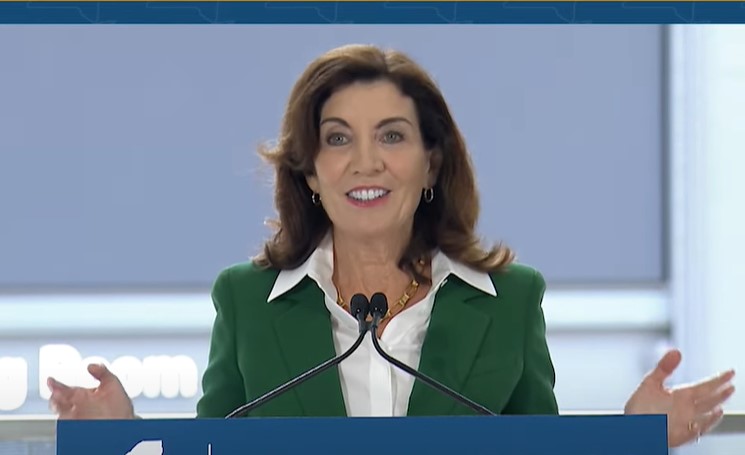
A 32-year-old woman named Anna Mochalova was arrested in New York City this week for stabbing a Rabbi with a syringe. She was charged with a hate crime. Two days later, the governor of the state with the largest Jewish population outside of Israel, Kathy Hochul, went on the record to explain that the spike in anti-Semitism is a messaging problem created by the Jews themselves.
The Democratic governor's remarks centered on her claim that Israel's response to the October 7 Hamas massacre had gone too far and shifted global sympathy away from the Jewish people. "I went to Israel right after Oct. 7," Hochul said. "I saw a lot of pain there. But I actually cautioned the government there, in private conversations, not to overreach."
She continued: "The world is with you when it comes to the brutal assault by a terrorist organization known as Hamas on innocent Israeli people. An overreach could change that dynamic, and that's what's happened."
Hamas butchered 1200 people, kidnapped mothers and children, raped women, and paraded the Israelis they abused around town. We all saw the pictures of the young German-Israeli woman Hamas had kidnapped from the music concert that was lying dead in the back of a pick up truck with her leg bent at an unnatural angle as they drove her abused, half-naked body around town to show off. The country that endured that horrific attack fought back. And the governor of New York is saying because Israelis did note lay down and absorb the blow fundamentally changed the "dynamic" of the conflict, meaning the victims made themselves less sympathetic by refusing to absorb the blow quietly. The word she kept reaching for was "overreach." Not Hamas's overreach. Israel's.
Hochul then pivoted to the domestic situation. "A lot of people are anxious about antisemitism, which is sky-high right now," she said. "And I take that personally, because I represent everyone." The construction is worth studying. Anti-Semitism is "sky-high" — acknowledged as fact. But the explanation she offered seconds earlier was that Israel provoked the shift in sentiment. So when she says she takes it personally, what she means is she takes personally the inconvenience of having to manage a political problem that, in her framing, the Jewish community's own homeland created.
She also volunteered that things would be "a lot easier" if Israeli Prime Minister Benjamin Netanyahu loses his next election. A sitting American governor publicly rooting for regime change in a democratic ally because the current leader makes her domestic politics harder. That's not diplomacy. That's a governor telling a foreign democracy to install someone more convenient for her press conferences.
Hochul governs a state where a woman just stabbed a Rabbi with a syringe and got charged with a hate crime. The governor's response was not to focus on the attackers, or the ideology driving the attacks, or the environment in New York City that has made visibly Jewish people targets on the street. Her response was to explain, at length, why Israel's decisions to fight back after being attacked was the reason Jewish people are hated and being attacked constantly in her state.
The analytical leap from "Hamas attacked Israel" to "Jewish New Yorkers face hate crimes because Israel hit back too hard" is not an explanation. It's a permission structure.