
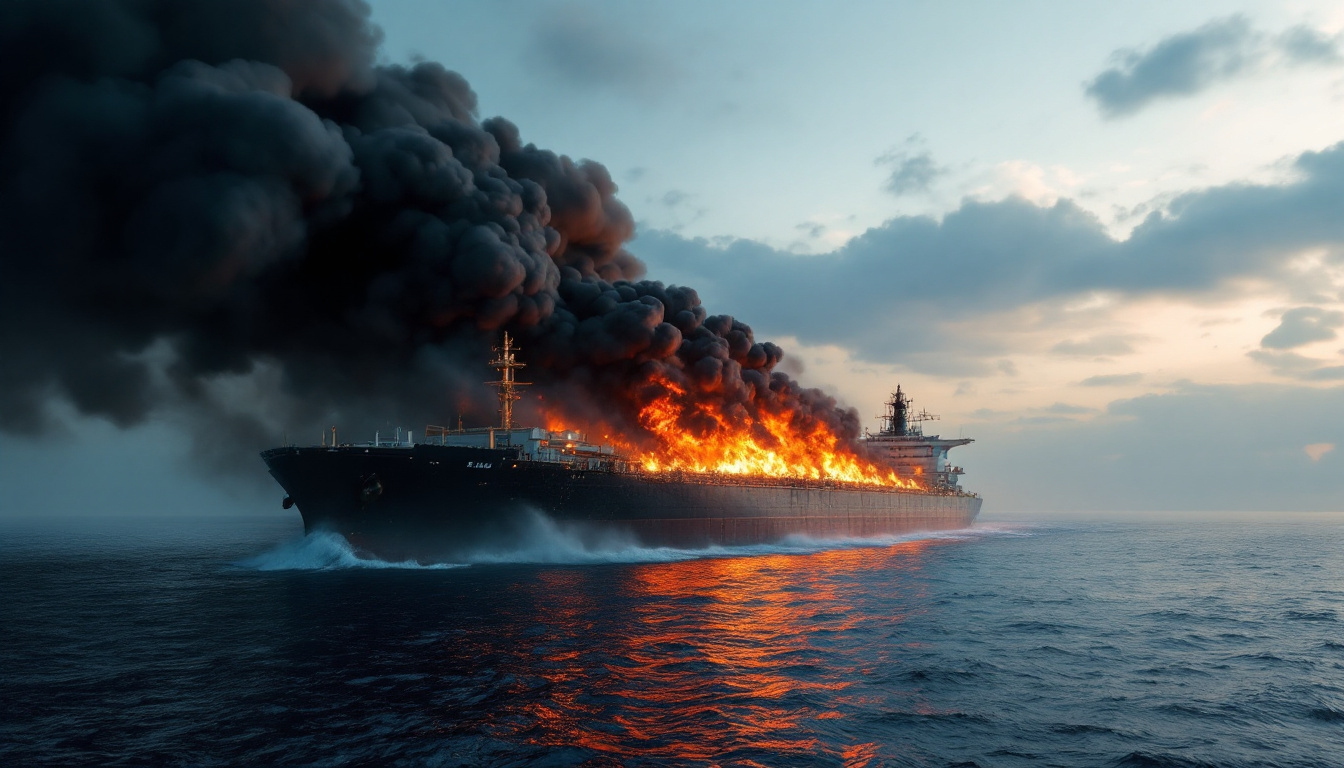
Two million barrels of Saudi crude are burning in the Strait of Hormuz right now. Onboard footage from the supertanker shows walls of black smoke rolling across the water after the vessel struck what's being reported as an Iranian naval mine — the kind of weapon designed to do exactly this, to exactly this kind of target, in exactly this stretch of sea.
Gas prices were already up. They're about to get worse.
The Strait of Hormuz handles roughly 20% of the world's daily oil supply. Every barrel that moves between the Persian Gulf producers and the global market passes through a corridor barely 21 miles wide at its narrowest point. Iran has mined it before — during the 1980s Tanker War, when the U.S. Navy had to escort commercial vessels through the same chokepoint. The difference between then and now is that in the 1980s, there was a military response. Operation Praying Mantis destroyed half the Iranian navy in a single afternoon in April 1988.
This time, footage shows crew scrambling as fire engulfs the deck of the supertanker, flames fed by the crude cargo beneath. Two million barrels. For context, that's roughly 10% of total U.S. daily oil imports sitting in one hull, and it's on fire because Tehran decided to seed international shipping lanes with explosives.
The immediate economic math is ugly. Brent crude futures spiked on the news. Shipping insurers are already recalculating risk premiums for every tanker scheduled to transit the Strait in the coming weeks. When insurance costs go up, freight rates follow. When freight rates climb, the price at the pump climbs with them. Every American who drives to work is about to subsidize Iran's aggression with an extra few bucks per fill-up.
The "diplomacy first" crowd has been remarkably quiet. These are the same voices that spent years insisting the Iran nuclear deal — the JCPOA — was the only framework that could moderate Tehran's behavior. Iran got billions in sanctions relief. They used it to build the very weapons now blowing holes in commercial shipping. The deal's architects told us engagement would produce stability. The Strait of Hormuz is producing black smoke.
Washington's energy policy makes the exposure worse. Every pipeline blocked, every drilling permit delayed, every LNG terminal stalled in regulatory review is a decision to stay dependent on oil that has to pass through waters Iran can shut down with a few thousand dollars' worth of Cold War-era mines. Domestic production doesn't transit the Hormuz. Permian Basin crude doesn't catch fire because a theocratic regime decided to make a point.
The strategic calculation from Tehran's side isn't complicated. Mine the strait, spike global oil prices, and watch the West's economies flinch — all without firing a shot that triggers Article 5 or a formal act of war. A mine is deniable. A mine is cheap. And a mine in the right shipping lane can do more economic damage than a missile strike on a refinery.
The price you'll pay at the pump next week just became Iran's latest foreign policy tool.