
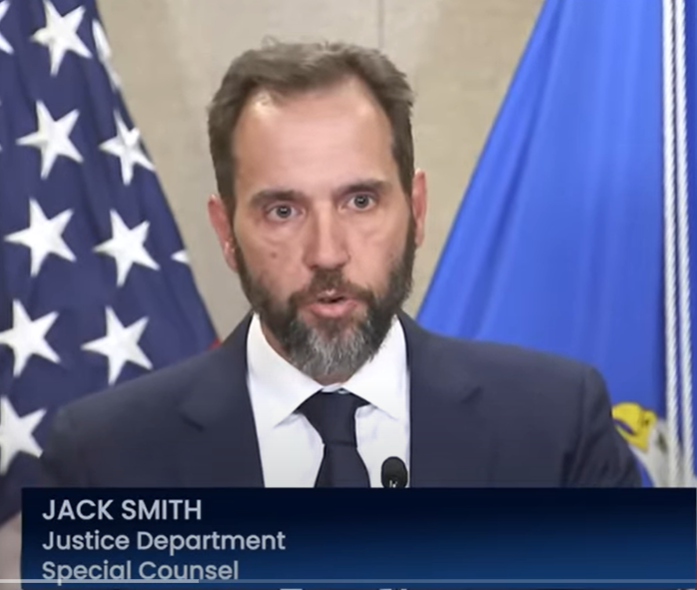
The National Archives' own Office of Inspector General classified its February 2022 message to the Justice Department as "-R" — a referral for "assessment and guidance," explicitly "not the same as a criminal referral for prosecution which is only done for criminal investigations." That's a direct quote from the OIG's internal case report, obtained by Senate Judiciary Committee Chairman Chuck Grassley.
Smith told a federal court the opposite.
In his court filings, the former special counsel claimed his classified documents investigation was "prompted by NARA's discovery of classified documents in the 15 boxes in January 2022 and a criminal referral from NARA in February 2022." Criminal referral. His words, under his signature, submitted to a judge. The document NARA actually produced says it wasn't one.
The distinction matters more than the legal class wants to admit. A criminal referral carries weight — it signals an agency has identified conduct serious enough to warrant prosecution. A routine referral for "assessment and guidance" is bureaucratic throat-clearing. Smith used the heavier term to justify the heavier investigation. The OIG's own language shows NARA never gave him that authority.
It gets worse. Internal communications obtained by Grassley reveal that the FBI's early assessment treated the entire matter as "spillage" — their term for classified material ending up somewhere it shouldn't — with "little likelihood of being pursued as a criminal matter." That's the FBI's own read before Smith was anywhere near the case. Spillage. Not espionage. Not obstruction. The kind of thing that typically ends with a security review, not a grand jury.
Then there's Gary Stern, NARA's general counsel, who the released records show was making substantive edits to DOJ court filings in the case. Smith's office had told the court that NARA played no role in "prosecutorial strategy." Stern's fingerprints on the filings suggest otherwise. An archive agency's lawyer doesn't redline a prosecutor's court submissions because he's bored on a Tuesday.
Smith sat before the Senate Judiciary Committee in Hart Senate Office Building Room 216 on September 29 and maintained he stood by his work. Grassley's committee had already released records showing Smith's investigative team secretly obtained text messages from 44 members of Congress through a NARA subpoena covering October 2020 through January 20, 2021. Eighty-four subpoenas were connected to Arctic Frost — the FBI investigation that preceded Smith's appointment — and his subsequent probe. Ten of those subpoenas targeted toll records associated with 20 current or former Republican members of Congress. The investigation eventually encompassed more than 400 Republican individuals and organizations.
House Judiciary Chairman Jim Jordan has referred Smith to the DOJ for allegedly making false statements to Congress about accessing lawmakers' text messages. Smith's defense — that he subpoenaed NARA for White House staff records, not congressional records specifically — is the kind of distinction that sounds precise in a hearing room and collapses the moment you learn his team downloaded and began reviewing the contents within an hour of receiving them. They weren't looking for filing errors.
Former FBI official Jody Weis described what the records show: investigative steps that kept "expanding and expanding and expanding, looking at any possible leads he could develop." Four hundred targets. Forty-four lawmakers' private messages. Nearly 4,800 checks subpoenaed from Americans who made small-dollar donations to President Trump between September 2019 and August 2023.
Smith called it a criminal referral. NARA's own inspector general called it something else entirely. The FBI called it spillage unlikely to be prosecuted. Gary Stern was editing filings Smith said NARA had no hand in.
The court got one version. The records tell another.