
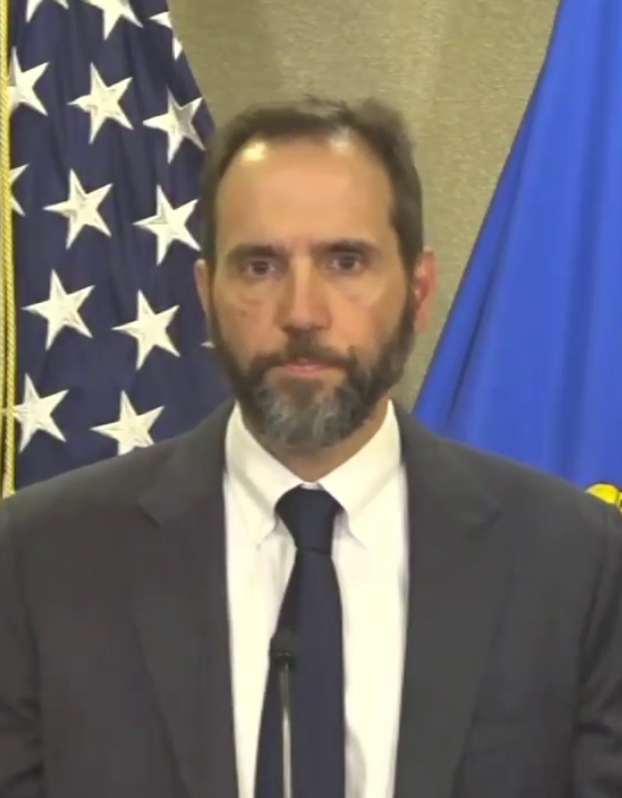
Forty-four sitting members of Congress had their private text messages accessed by Jack Smith's special counsel team starting in August 2023. Not one of them was told.
In December 2025, Smith swore under oath that he didn't spy on text messages belonging to members of Congress. DOJ records released this week say otherwise. We even have video evidence of him lying under oath...
Senate Judiciary Chairman Chuck Grassley (R-IA) dropped the hammer on Monday, confirming that Department of Justice records show Smith's investigators reviewed the contents of text messages sent by 44 members of Congress. The materials came from the National Archives, which handed over White House records covering October 2020 through January 2021 — a window that conveniently captured every Republican communication with senior White House officials in the final months of the Trump administration.
"I received records from DOJ confirming Jack Smith's investigative team reviewed the contents of text messages sent by 44 members of Congress," Grassley said. He added that he's "alerting my colleagues who were impacted" and plans to release the records alongside Sen. Ron Johnson (R-WI) "so the American people can see the evidence."
Grassley wasn't finished. "Jack Smith has answering to do, and I intend to have him before the Senate Judiciary Committee."
Sen. Rand Paul (R-KY) put a finer point on the timeline problem. "December 2025: Jack Smith swore under oath that he didn't spy on text messages belonging to members of Congress," Paul said. "This is a blatant abuse of power, and exactly what our Founders warned about."
Rep. Elise Stefanik (R-NY) confirmed she was among the targets, stating that Smith's team "unlawfully and unconstitutionally accessed my private text messages, along with 43 other Members of Congress." The constitutional issues here aren't subtle — the Speech and Debate Clause exists specifically to prevent the executive branch from using investigative power to rifle through legislators' communications. Attorney-client privilege applies to a fair number of those texts too.
Smith's team was supposedly investigating January 6, 2021, and the events surrounding it. That's a narrow mandate. Accessing the private communications of 44 lawmakers — without notice, without individual warrants, without any apparent limiting principle — is something else entirely. It's a fishing expedition conducted through the National Archives' back door.
The special counsel's office has maintained that the materials were lawfully obtained through a subpoena for White House records. Which is technically true in the same way that ordering a pizza and eating your roommate's leftovers from the same fridge are both "getting food from the kitchen." The subpoena was for presidential records. The texts of 44 legislators came along for the ride, and nobody on Smith's team seems to have paused to ask whether the Constitution had anything to say about that.
The scope of this surveillance goes far beyond what was previously disclosed to the public or to Congress itself. The investigation was sold as a case about one man — Donald Trump — and one day. What the DOJ records reveal is a dragnet that swept up an entire caucus.
Grassley has the subpoena power to compel Smith's testimony. Smith has a sworn statement on the record that directly contradicts what the DOJ's own documents show. One of those two things is going to have to give.
Either Jack Smith lied under oath about accessing congressional communications, or the DOJ's records are fabricated. Both options end in the same place.