
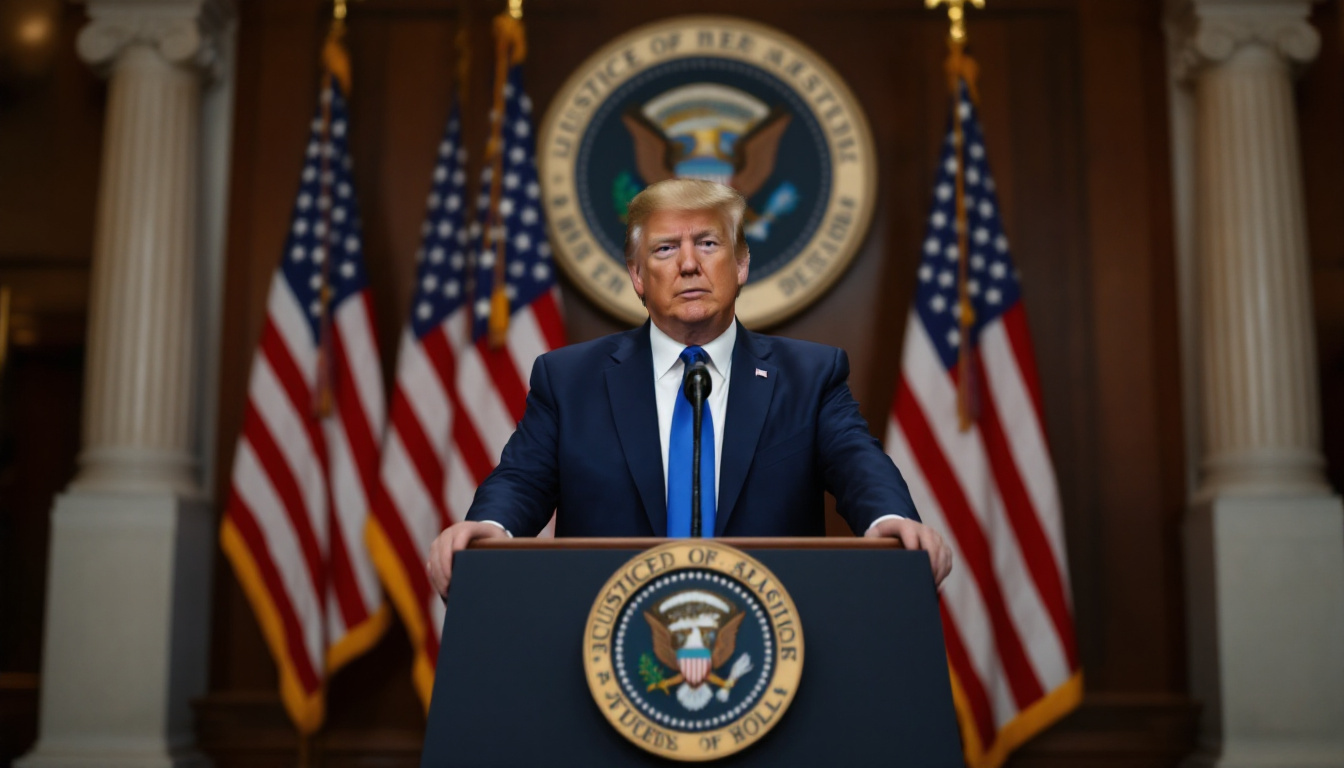
Marc Klaas stood in the Justice Department's Great Hall on Saturday and said what thirty years of trusting the system got him. His daughter Polly was kidnapped from a slumber party and murdered by Richard Allen Davis in 1996. Davis was sentenced to death. Klaas was told by the prosecutor to trust the process.
"Today, 30 years later, I'm finding out that that's not the truth," he said.
Two days after the midterm elections, California Governor Gavin Newsom signed commutation orders for all 548 death row inmates in the state — the largest mass commutation in American history, emptying the largest death row in the Western Hemisphere. Of those 548 cases, 382 still require California Supreme Court approval. The rest take effect immediately.
Newsom didn't start here. He issued a blanket moratorium on executions in 2019. California hasn't actually executed anyone since 2006. But voters rejected abolishing the death penalty twice — in 2012 and again in 2016. The sentences Newsom just erased were sentences the people of California voted to preserve.
President Trump responded by doing something Newsom apparently never considered. He invited the families.
Trump called the commutations "one of the most shocking acts of injustice our country has ever seen" and said Newsom "came along and stole away the only closure those families might ever have." The White House circulated a list of 20 of the most notorious killers whose sentences were wiped — names like Bob Williams, convicted of rape and murder in Bakersfield in 1994. Marcus Wesson, who killed nine of his own family members in Fresno in 2004. Randy Kraft, convicted of 16 murders. Charles Ng, convicted of 11 — including two infants.
Kern County District Attorney Cynthia Zimmer, who appeared at the event, said Newsom "didn't know the names of the defendants or even the names of the victims." That's worth sitting with. The governor commuted 548 sentences without knowing who he was sparing or who they killed.
Newsom's office has framed this as a moral stand against capital punishment. The framing requires you to ignore that California voters were asked directly — twice — whether they wanted to end the death penalty, and said no both times. Newsom didn't change minds. He overruled them.
Trump used the event to announce new federal directives. Under Attorney General Todd Blanche, the DOJ has authorized 44 defendants for the federal death penalty and sought it 49 times since Trump's January 2025 Inauguration Day executive order. Under the previous administration, the death penalty was sought exactly once. "Capital punishment will be swift and certain," Trump said. The White House statement added that officials "must stop playing politics with public safety."
Rep. Brandon Gill, Republican from Texas, has introduced the "Just Punishment for Murder Act" — House Bill 11132 — which would create a federal pathway to pursue the death penalty in cases where states refuse to. The bill targets a specific gap: roughly 70% of the condemned inmates Newsom just spared met a multiple-felony condition that could qualify them under federal statute.
The contrast from this weekend isn't subtle, and it isn't supposed to be. One governor signed papers in Sacramento emptying death row without learning a single victim's name. One president flew the families to Washington and put them behind a podium.
Marc Klaas called it a "knife in the back." He'd waited thirty years for the system to deliver what it promised. Newsom delivered something else — to 548 killers, all at once, the week of Thanksgiving.