
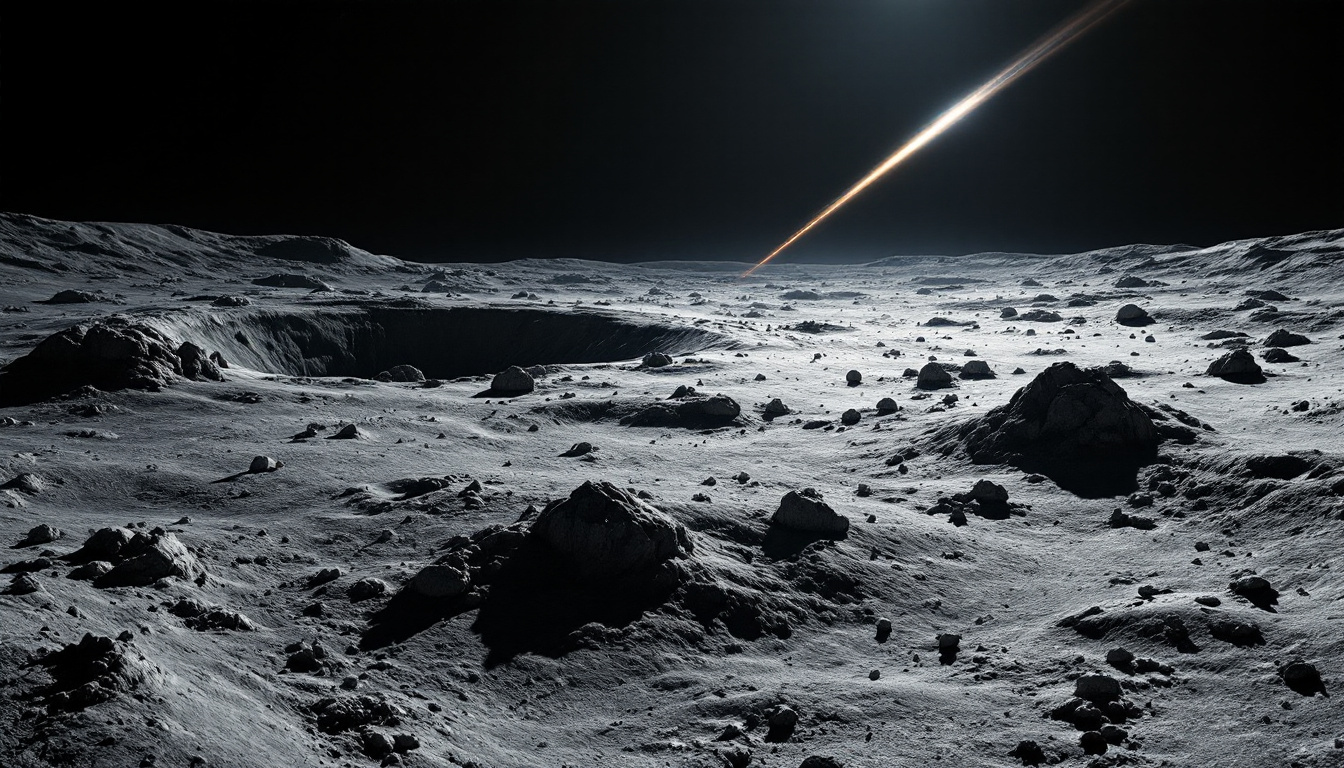
A 10,000-pound spent SpaceX Falcon 9 upper stage — catalog designation 2025-010D — has been drifting through space for 19 months. On Wednesday, August 5, at approximately 06:35 UTC, it will smash into the lunar surface near Einstein Crater at 5,400 miles per hour. The impact will carry the equivalent force of 3 tons of TNT.
And NASA can barely contain its excitement.
The rocket stage, roughly 12 meters long and 4 meters wide, launched in January 2025 carrying two private robotic landers to the moon. Once its job was done, the hollow metal shell was set adrift — standard practice for upper stages that don't have enough fuel to redirect into a solar orbit or a controlled reentry. Astronomer Bill Gray, who has been tracking the object's trajectory, first identified the collision course and pinpointed the impact site on the moon's sunlit eastern limb.
NASA Public Affairs Officer Jimi Russell confirmed the agency is watching closely. "Using publicly available data, independent astronomers were the first to note the upcoming lunar impact event of a SpaceX Falcon 9 rocket's upper stage from a mission launched in January 2025," Russell said, as reported by Newsmax. NASA's Lunar Reconnaissance Orbiter and South Korea's Danuri lunar orbiter are both being repositioned to capture before-and-after imagery of the crash.
The expected result: a fresh crater 20 to 30 meters in diameter — about the length of a basketball court — and a dust plume reaching several kilometers above the surface. Scientists say the brief impact flash may even be visible through telescopes from the eastern United States and parts of South America.
Steven A. Hauck, Chair of Earth, Environmental and Planetary Sciences at Case Western Reserve University, put the environmental hand-wringing in perspective. "The debris of this small impact will remain at the moon," Hauck noted. Which is a polite way of saying the moon — a barren rock with no atmosphere, no water cycle, and no HOA — will survive just fine.
That hasn't stopped the predictable chorus from treating this like an ecological disaster. Some outlets have already started running headlines about Elon Musk "littering" in space, as if the man who single-handedly rebuilt American launch capability is the problem. The moon has been absorbing asteroid impacts for 4.5 billion years. It has roughly 9,000 craters larger than 12 miles across. One more dent the size of a tennis court isn't exactly a conservation crisis.
The real story here isn't the impact — it's what it reveals about who's actually doing things in space. SpaceX launched this mission to deliver private lunar landers. NASA is using the aftermath as a free research opportunity to study lunar geology. Meanwhile, the regulatory class is workshopping talking points about "responsible space stewardship" from agencies that couldn't get a rocket off the ground without SpaceX's help.
The Associated Press noted this collision could have been avoided entirely if SpaceX had nudged the upper stage into a solar orbit after payload delivery. That's a fair engineering critique. What it's not is evidence that commercial spaceflight is reckless. SpaceX has launched more missions in the last five years than every other launch provider on Earth combined. One uncontrolled lunar impact out of hundreds of successful missions is a batting average most government programs would kill for.
Wednesday morning, a hollow metal tube will hit a dead rock at seven times the speed of sound, and a handful of orbiting cameras will photograph the scar. Scientists will study the ejecta, update their models, and publish papers. The moon won't notice.
The people complaining about it will never launch anything.