
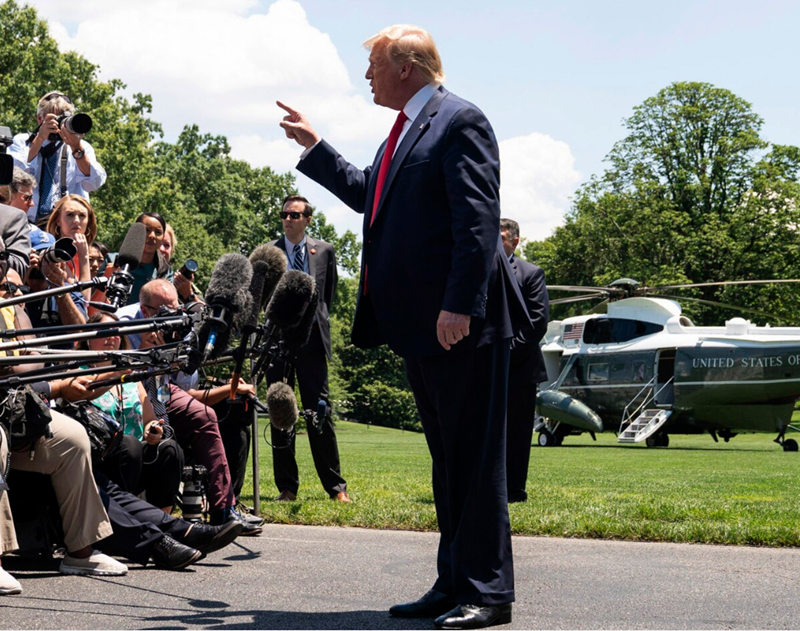
President Trump put three of the nine justices on the Supreme Court. On Monday, he lit into all of them on Truth Social after the Court blocked his executive order establishing uniform mail-in ballot standards through the United States Postal Service.
"These are not the people I interviewed to serve on the United States Supreme Court," Trump wrote. "They are merely a shell of their original selves."
The executive order, signed in March 2026, directed the USPS to implement a barcode verification system for mail-in ballots — a standardized tracking mechanism designed to confirm that ballots entered the postal system from verified locations and arrived at counting facilities with a verifiable chain of custody. The Supreme Court ruled the order could not be implemented before the 2026 elections, with Justice Brett Kavanaugh writing that the timeline was insufficient and that enforcement would be "arbitrary and capricious" under the Administrative Procedure Act.
Justice Clarence Thomas and Justice Samuel Alito dissented. Kavanaugh — a Trump appointee — sided with the majority. So did Justice Amy Coney Barrett and Justice Neil Gorsuch, the other two justices Trump placed on the bench.
Three nominees. Three votes against the president who nominated them. Trump's response was not diplomatic.
"Republicans just got another bad decision from the United States Supreme Court, one that the Court System took forever to give," he posted. He framed the ruling alongside previous Court decisions on tariffs and birthright citizenship where his appointees broke with his agenda. Then he added: "It is not easy for me to write this criticism of the United States Supreme Court — it will likely cost me dearly for years to come — but I feel it my obligation and duty, as President, to do so for the America we love!"
The League of Women Voters celebrated the decision. CEO Celina Stewart said, "Today, the Supreme Court refused to allow the federal government to throw our elections into chaos just weeks before Election Day." That framing — barcode verification as "chaos" — tells you everything about which side views election security measures as a threat.
Kavanaugh's reasoning rested on timing, not substance. The argument wasn't that barcode verification was unconstitutional or that mail-in standards were outside the executive's authority. The argument was that implementing the system this close to an election would create logistical problems for state officials. The substance of the order — whether uniform standards would make elections more secure — went entirely unaddressed.
This is the third time in two years that Trump's own Supreme Court picks have blocked a signature initiative. Tariffs. Birthright citizenship. Now election integrity. The pattern doesn't suggest a rogue Court — it suggests justices who internalized the establishment's procedural caution the moment they got lifetime appointments. The confirmation hearings are the audition. The rulings are the real performance.
Trump built the most conservative Supreme Court in a generation. He handed them the seats, took the political hits, spent the capital. The barcode system sits on a shelf. The 2026 midterms will run under the same patchwork of state mail-in rules that existed before March.
He gave them the Court. They gave him the Administrative Procedure Act.